MAKING CONTRAST COMPUTABLE: SOBEL GRADIENTS, DENSITY VS. INTENSITY, AND THE ASET BLUE MYTH
A quick note: I’m not a trained gemologist. No GIA diploma, no mineralogy degree, and no traditional bench apprenticeship. Just a software engineer who fell down the rabbit hole of faceting machines, geometry, and how light bounces around inside crystals.
Ask three experienced gem cutters what gives a finished stone "life" on the hand, and they will reach for words from photography and music: pop, crispness, snap, checkerboard flash, crushed ice. Every cutter recognizes contrast the instant a stone tilts under room lighting. Without dark reflections of the observer's head and shoulders interrupting bright reflections of the overhead sky, even complete light return looks like a flat white bathroom mirror.
Yet for decades, contrast in gemstone design remained either an unquantified artistic vibe or a crude single-frame shortcut: counting how much blue ink appeared inside a static face-up ASET diagram. You cannot feed an artistic vibe into a GPU optimizer evaluating thousands of candidate polyhedra per second. And as our catalog data shows, optimizing for static ASET blue area actually steers an algorithm straight into central ink-puddle extinction.
To build ProFacet and OffTheDop, we had to make spatial contrast mathematically computable across real 3D tilt, and split it into two independent physical dimensions that traditional gemology never separated: how finely light and shadow are woven across the crystal (Contrast Density) versus how steeply each bright-to-dark cliff drops (Contrast Intensity).
From Subjective Pop To A 19-angle Gpu Sobel Operator
If you want a computer to measure contrast the way a human eye experiences scintillation, you have to model two physical realities at once: spatial edge detection across neighboring pixels on the retina, and motion as the stone rocks back and forth on a finger or pendant.
Inside ProFacet's WebGPU optical analyzer (local_contrast_atlas.wgsl), every candidate gemstone runs through a four-stage spatial gradient pipeline in less than a millisecond:
- A multi-angle raytracing atlas: Rather than judging a stone frozen face-up, the GPU raytraces 19 tilt frames sweeping from -45° to +45° under a realistic lighting hemisphere that includes the dark viewer head-shadow cone, mid-angle ambient sky, and bright overhead illumination.
- Perceptual luminance and rim erosion: Each pixel's RGB return is converted into human photopic luminance, and the outer gemstone silhouette is eroded inward by one pixel. Without that rim erosion, any bright stone sitting against a black background gets rewarded with a fake ring of free contrast around its girdle perimeter, biasing an optimizer toward jagged outlines.
- Sobel spatial gradient convolution: At every interior pixel, the shader slides horizontal and vertical 3x3 Sobel derivative kernels across its eight neighbors to measure local edge gradient magnitude. Smooth, uniform slabs of light evaluate near zero; sharp facet-to-facet jumps between overhead sky and dark head-shadow light up as crisp ridges.
- Separating Density from Intensity: Averaging edge strength blindly across a stone confuses a dense grey silk pattern with two giant black-and-white bars. Instead, ProFacet splits the gradient map into two distinct signals: Contrast Density (the share of interior crystal pixels carrying an active optical boundary, measuring how finely light and shadow interleave) and Contrast Intensity (the average gradient steepness strictly along those active boundaries, measuring how sharply each cliff snaps from bright to dark).
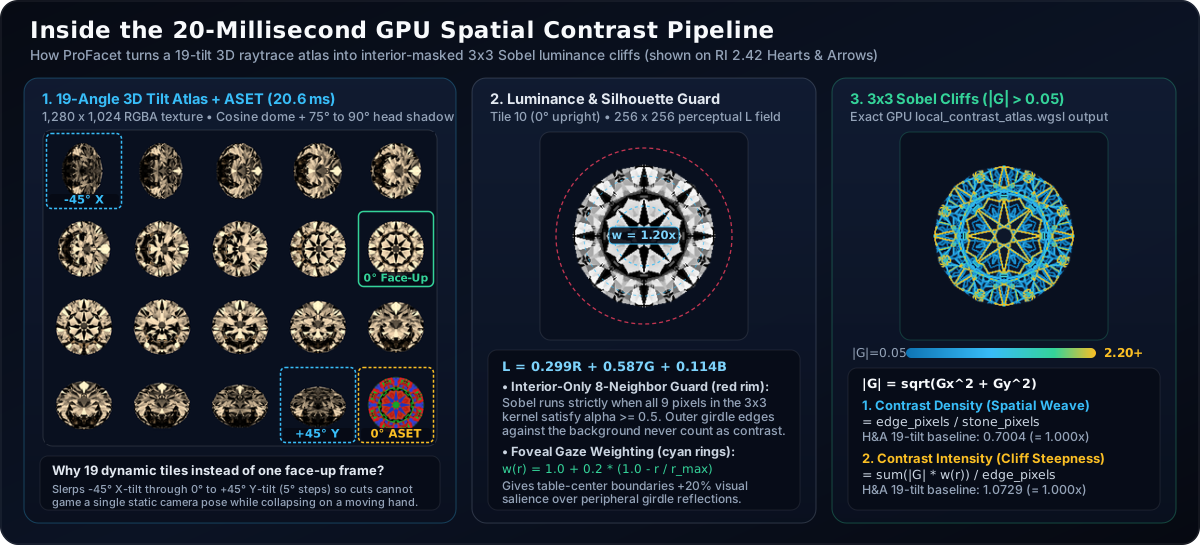
Across the tilt sweep, ProFacet weights angles near face-up highest while still demanding strong retention out to 45°, normalizes both metrics against a classic Diamond Hearts & Arrows round brilliant (set to 1.00x), and applies a smooth diminishing-returns curve above unity so an optimizer never sacrifices brightness just to chase microscopic aliasing.
Why Static 0-degree Aset Blue Fails To Predict Contrast
Anyone who has shared a faceting diagram on an online gemology forum has met the ASET Blue rule of thumb. In an ASET map, red marks overhead light, green marks low-angle ambient light, and blue marks the narrow cone blocked by the observer's head and camera lens. Because viewer head-shadow is the raw ingredient that creates dark contrast facets in a diamond, conventional wisdom jumped to a convenient shortcut: just measure the percentage of blue pixels in a static face-up ASET diagram to grade contrast.
We tested that shortcut directly against 3D multi-angle Sobel contrast across nearly 4,800 catalog designs sampled evenly across all eight refractive indices, from Quartz up to Moissanite.
The result is sobering: static face-up ASET Blue percentage has almost zero ability to predict real 3D contrast (correlating at r = -0.17), and what slight trend exists actually points in the wrong direction:
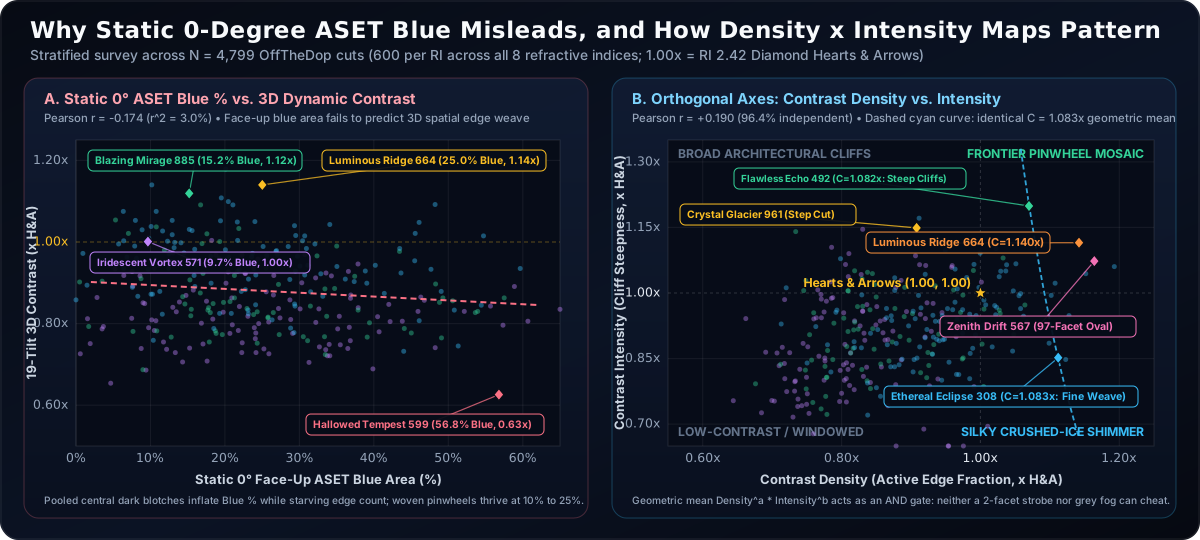
Counting face-up blue ink fails because area is not perimeter, and a frozen snapshot is not 3D motion:
- The ink-puddle trap: Pour half a bottle of blue ink into one broad rectangle under a step-cut table and your blue area skyrockets, yet there is only a single boundary loop around the puddle. Quartz step cut Hallowed Tempest 599 and Beryl step cut Crimson Serenade 499 flood more than a third to half of their face-up ASET maps with blue, yet score poorly in 3D contrast because large contiguous blocks of head-shadow read to the eye as central extinction rather than sparkle.
- The finely braided mosaic: Take less than 10% face-up ASET Blue and braid it across 69 non-opposing cushion-trilliant facets in Quartz Showcase cut Iridescent Vortex 571. Every small dark reflection is completely surrounded by bright sky-lit neighbors, multiplying edge perimeter and keeping fresh dark-bright swaps firing as the stone tilts. With modest static blue area, it matches Diamond Hearts & Arrows contrast inside ordinary rock crystal.
Four Contrast Personalities: Wisely Chosen Examples From The Catalog
As the right half of Figure 2 shows, Contrast Density and Contrast Intensity are nearly independent across our catalog. On OffTheDop, we combine them into a single headline Contrast score weighted predominantly toward spatial weave with a smaller bonus for edge sharpness.
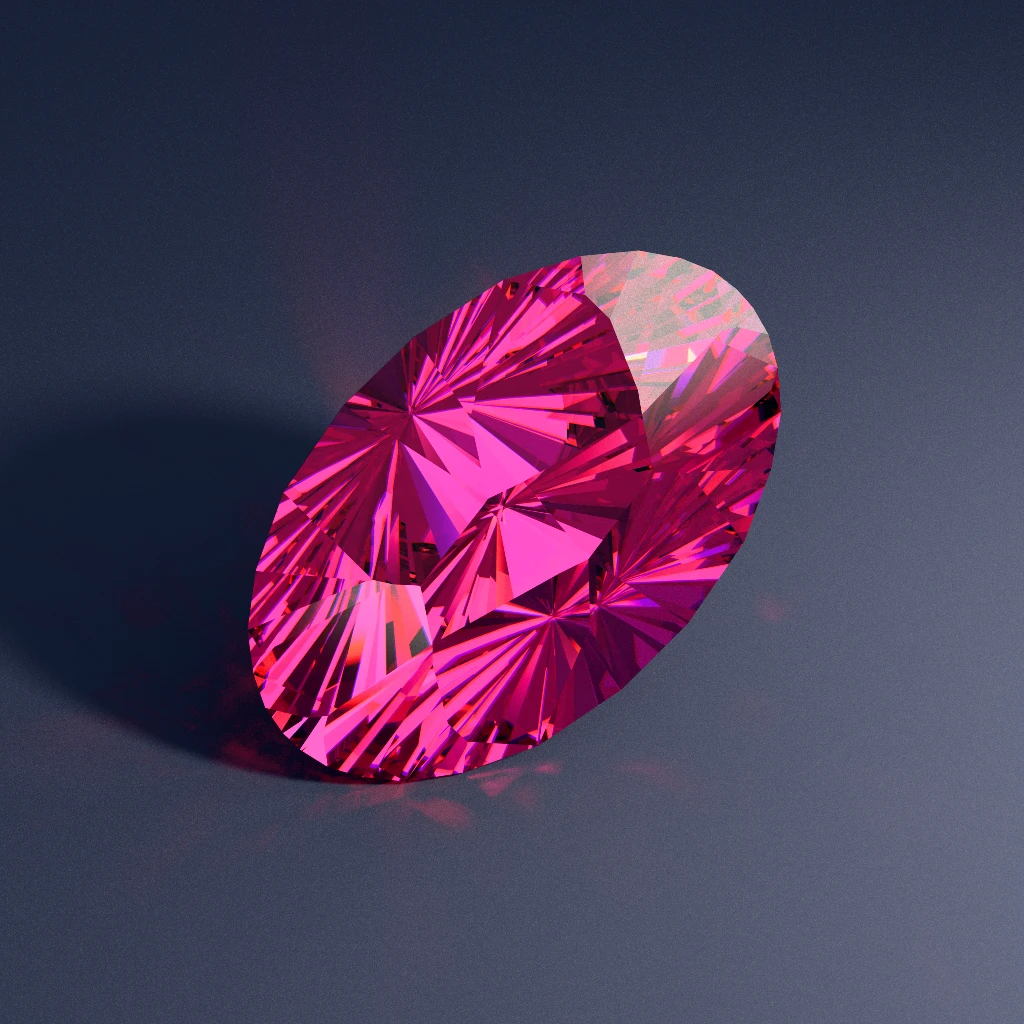
Because those two underlying axes are independent, two gemstones with the exact same headline Contrast score can look remarkably different in person, while lower-density architectural cuts can still deliver striking terrace drama. Here are four curated Showcase and Signature designs drawn from four corners of that space:
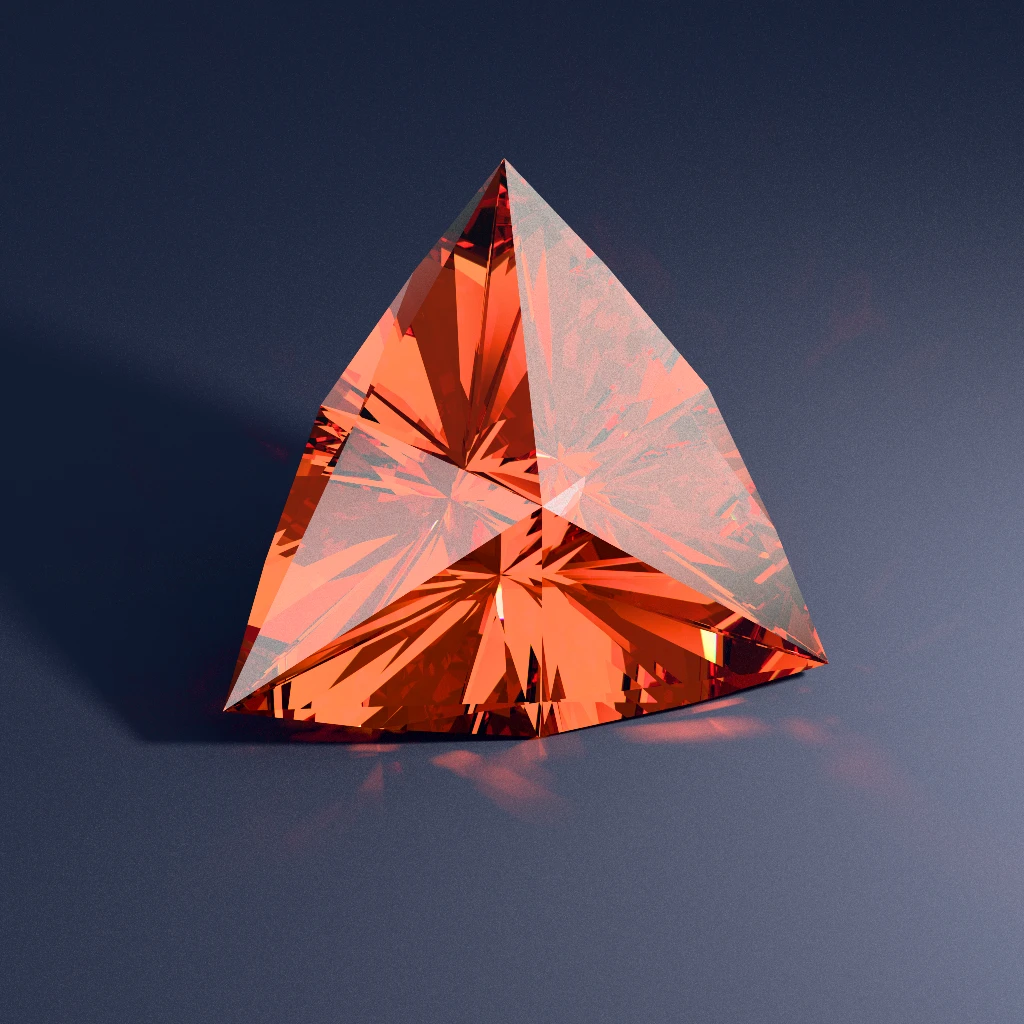
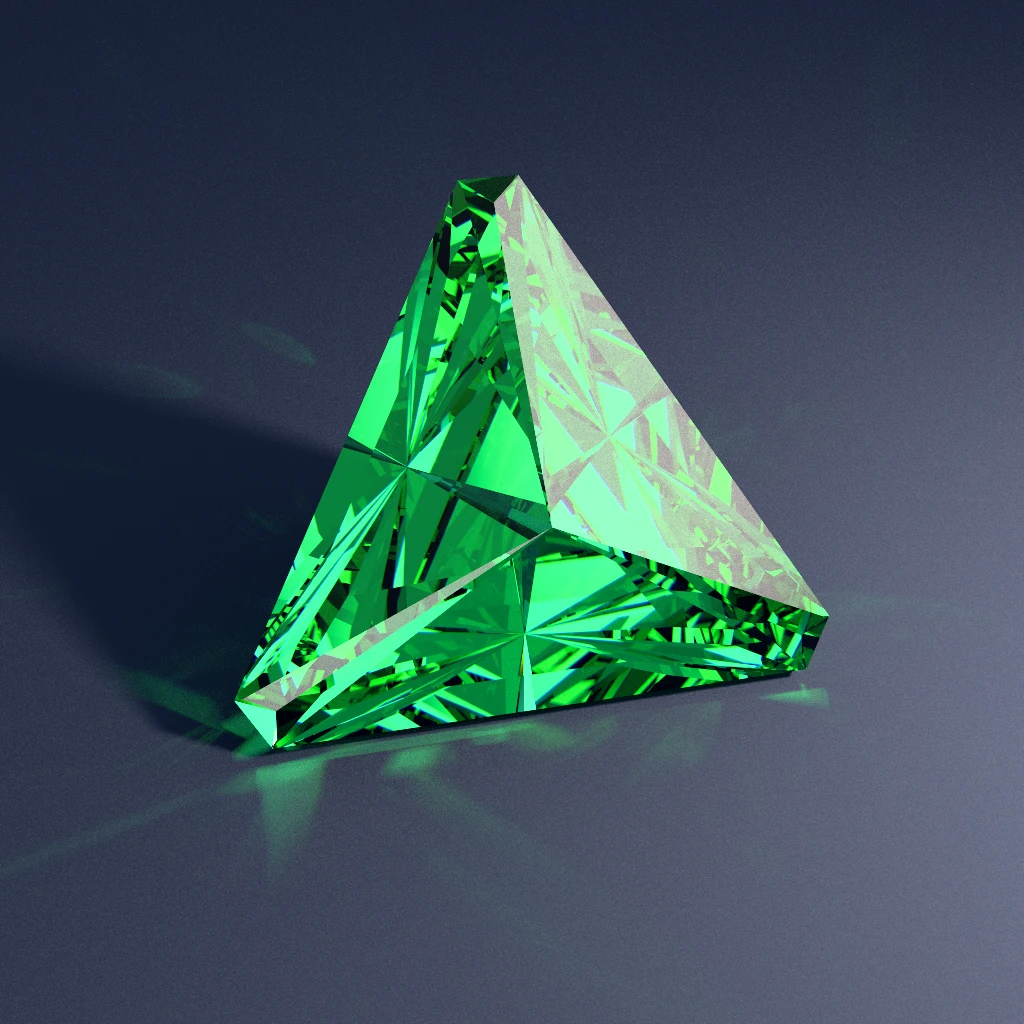
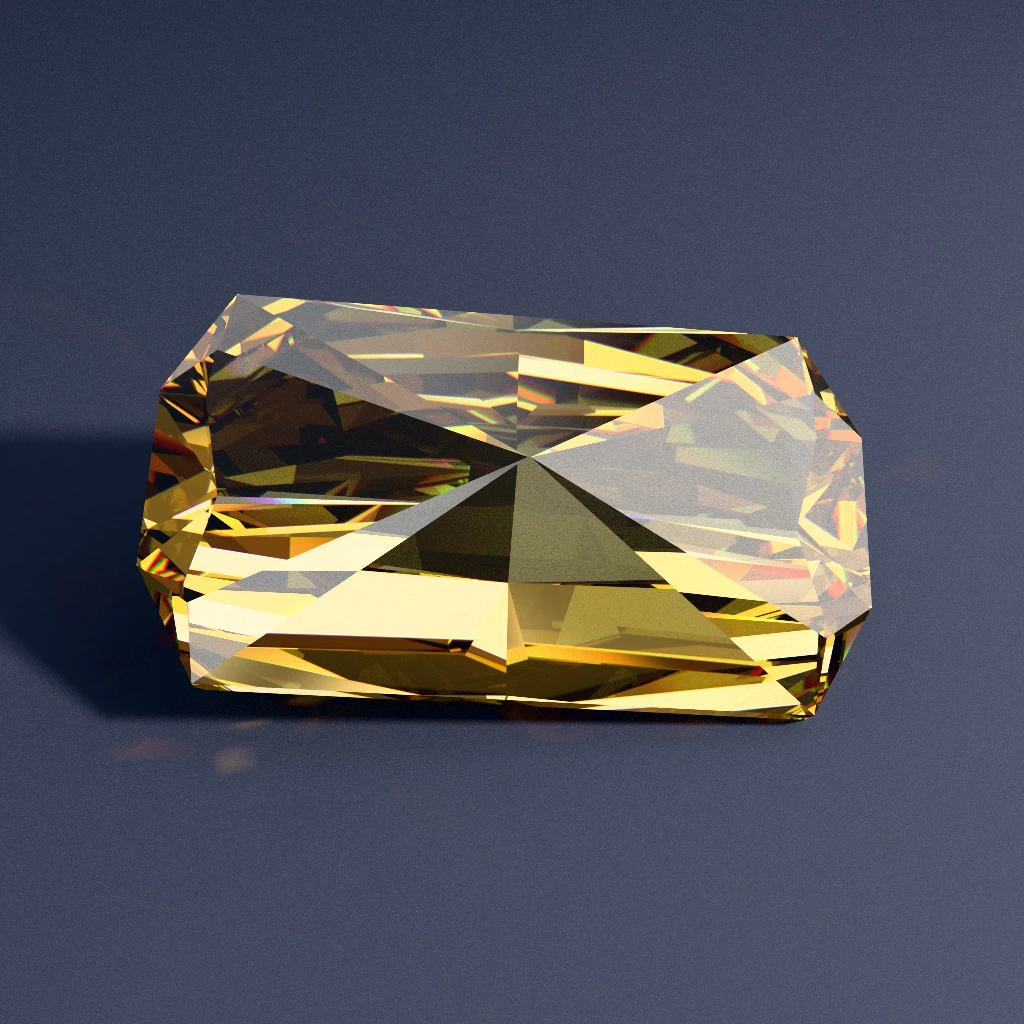
Compare the top pair in that gallery, Ethereal Eclipse 308 and Flawless Echo 492. Both are RI 2.15 trilliants with identical brightness and the exact same 1.08x combined Contrast score, yet any jeweler holding them side by side immediately sees two distinct personalities:
- Ethereal Eclipse 308 bows its three outer walls outward, splitting internal reflections into a fine lattice of soft silver-to-slate transitions (explored further in our companion post on Shannon Entropy in Gemstone Design).
- Flawless Echo 492 uses straight truncated corners to lock broad pavilion mirrors directly against dark head-shadow triangles, pushing edge cliff steepness nearly twenty percent past Diamond Hearts & Arrows for bold graphic drama.
The same contrast mechanics scale cleanly from low-RI Quartz up to Diamond:
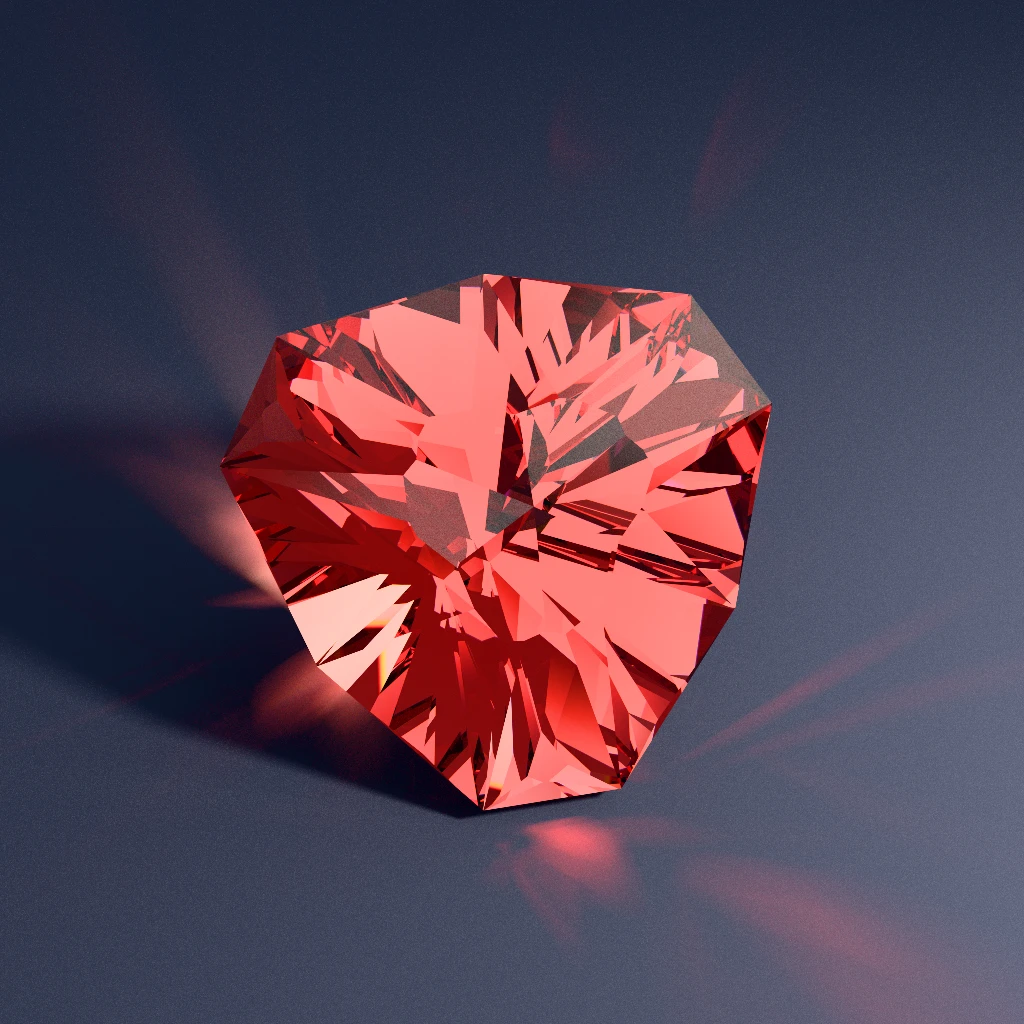
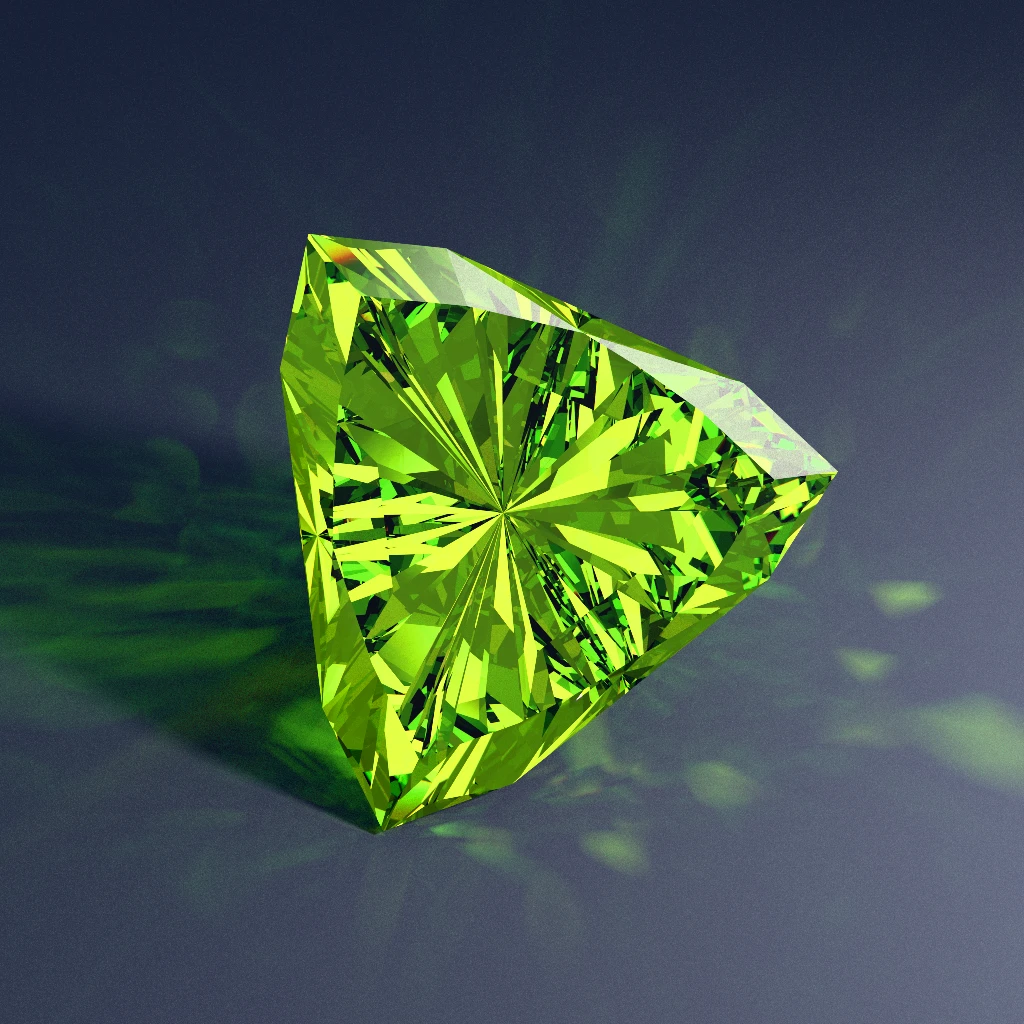
Here is how those seven designs compare against the Diamond Hearts & Arrows baseline (1.00x):
| Design | Material | Brightness | Density | Intensity | Combined Contrast | Face-Up ASET Blue | Visual Personality |
|---|---|---|---|---|---|---|---|
| Hearts & Arrows (Round ref.) | Diamond 2.42 | 1.00x | 1.00x | 1.00x | 1.00x | 22% | Classic radial benchmark |
| Luminous Ridge 664 | Moissanite 2.67 | 1.07x | 1.14x | 1.12x | 1.14x | 25% | Electric weave and steep cliffs |
| Flawless Enigma 461 | Diamond 2.42 | 1.06x | 1.15x | 1.13x | 1.15x | 22% | Frontier diamond scintillator |
| Zenith Drift 567 | CZ 2.15 | 0.93x | 1.16x | 1.07x | 1.16x | 19% | Bowtie-free crushed-fire oval |
| Ethereal Eclipse 308 | CZ 2.15 | 1.04x | 1.11x | 0.85x | 1.08x | 21% | Dense, velvety woven silk |
| Flawless Echo 492 | CZ 2.15 | 1.04x | 1.07x | 1.20x | 1.08x | 28% | Bold graphic piano-key cliffs |
| Crystal Glacier 961 | CZ 2.15 | 0.73x | 0.91x | 1.15x | 0.93x | 4.5% | Crisp architectural step terraces |
| Iridescent Vortex 571 | Quartz 1.54 | 1.10x | 1.00x | 1.02x | 1.00x | 9.7% | Diamond-level contrast in Quartz |
Tilt Stability And Steering Contrast In Profacet And Offthedop
Why evaluate Sobel gradients across 19 tilt angles instead of running edge detection once on the face-up image? Plotting real optical retention across the full viewing arc makes the difference obvious:
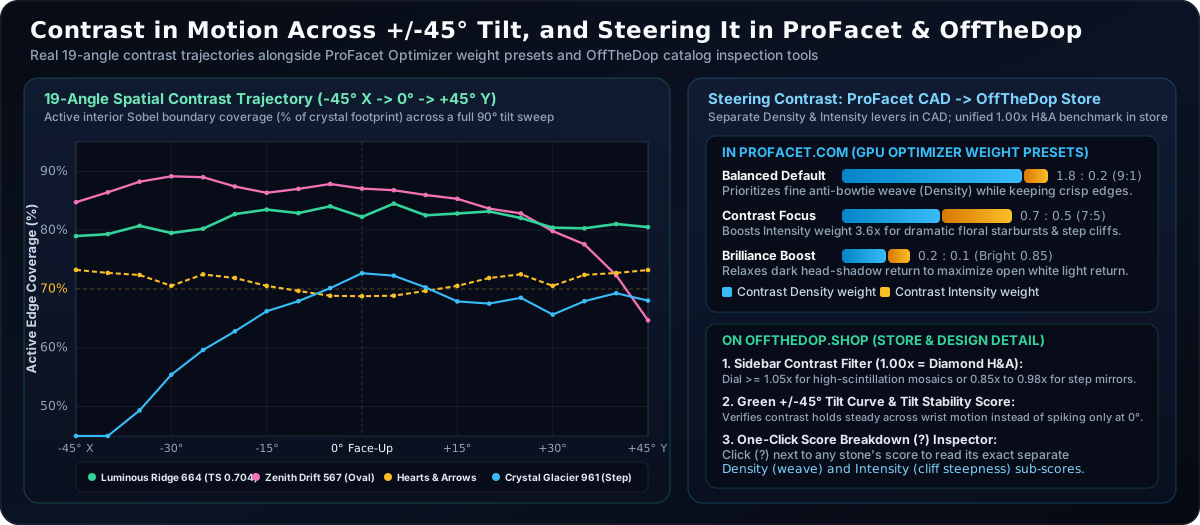
A cut tuned strictly for a vertical camera looks respectable dead-center, then opens a wide tilt window the moment a wearer rotates their wrist. Multi-angle Sobel scoring keeps contrast alive across the entire gesture.
Both platforms put these controls directly in your hands:
- In ProFacet Studio: Every angle edit updates live readouts for Contrast Density and Contrast Intensity alongside Brightness, Dispersion, Windowing, and Entropy. In the GPU optimizer, you can steer both contrast sliders independently or pick tailored presets such as Scintillation Focus for maximum sparkle weave, or Step Cut / Emerald to sharpen broad terrace cliffs without fighting a rectangular outline.
- On OffTheDop: You can filter and sort over 92,000 designs by 3D Contrast, Brightness, Material, and Base Shape, inspect the full 19-angle tilt curve inside every design modal, or let Design Finder learn your personal contrast taste through visual A/B comparisons.
Even with multi-angle Density and Intensity in place, our GPU optimizer uncovered one more surprise. Occasionally a cut scored high on both Brightness and Sobel Contrast, yet rendered like a stark black-and-white barcode with almost no silvery midtones in between. Solving that blind spot meant bringing Claude Shannon's information theory into gemstone optics, which is the story of our companion post: All Thirty-Two Shades of Grey: Bringing Shannon Entropy to Gemstone Design.
Steer Contrast Live in ProFacet or Read Companion Post on Shannon Entropy
Experiment with Contrast Density and Contrast Intensity sliders in ProFacet Studio, filter 92,000+ path-traced cuts by 3D Contrast on OffTheDop, or continue to Part 2 on 32-bin Claude Shannon Information Entropy.