ALL THIRTY-TWO SHADES OF GREY: BRINGING SHANNON ENTROPY TO GEMSTONE DESIGN
A quick note: I’m not a trained gemologist. No GIA diploma, no mineralogy degree, and no traditional bench apprenticeship. Just a software engineer who fell down the rabbit hole of faceting machines, geometry, and how light bounces around inside crystals.
In 1948, Bell Labs mathematician Claude Shannon published A Mathematical Theory of Communication and introduced Information Entropy, a simple equation that measures how much genuine variety and nuance a signal carries across its alphabet of states. Over the past eight decades, Shannon's formula has reshaped data compression, cryptography, thermodynamics, medical imaging, and camera autofocus.
Yet as far as we know, Shannon Entropy has never before been used as an optical metric or design target in gemstone faceting.
We did not add information theory to ProFacet and OffTheDop just to borrow a famous equation. We added it because our GPU optimizer forced our hand. Once we made Brightness and 3D Spatial Contrast computable, the optimizer occasionally handed back high-scoring crystal geometries that looked strangely flat, metallic, and binary, flashing strictly between pitch-black voids and blown-out white glare like a harsh QR code. Those stones had plenty of light return and plenty of sharp edges, yet they lacked the liquid-silver vocabulary of slate, pewter, dove-grey, and pearl that makes a fine gemstone look deep. Shannon Entropy turned out to be the exact lens that measures those missing shades of grey.
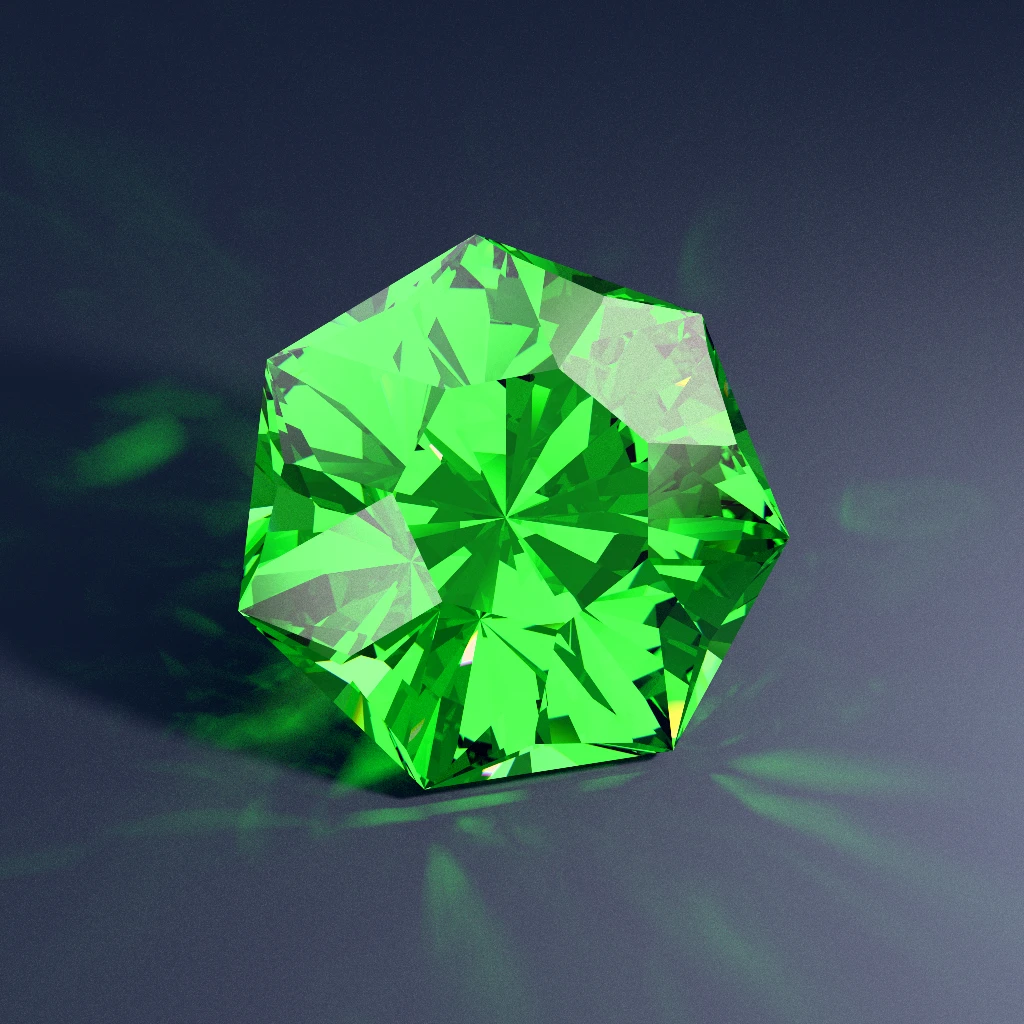
The Binary Strobe Blind Spot: What Brightness And Contrast Miss
To see why traditional gem metrics miss tonal richness, consider what each one actually measures:
- Brightness measures average returned energy. A stone filled evenly with medium silver light and a stone split half into dead black and half into blinding white share the exact same average brightness.
- Spatial Contrast (covered in our companion article) measures local edge jumps between neighboring pixels. That half-black, half-white checkerboard produces huge edge gradients along every facet border.
Neither metric ever asks a basic perceptual question: how many distinct shades of luminance coexist across the face of the stone?
Inside ProFacet's WebGPU analyzer (shannon_entropy_atlas.wgsl), we measure that tonal palette directly across all 19 tilt angles from -45° to +45°:
- Thirty-two perceptual luminance bins: Within each tilt frame, every interior gemstone pixel is sorted by human photopic luminance into one of 32 equal tonal buckets from pure black to peak white. Four buckets would be too coarse to separate smooth gradation from posterization; 256 buckets would chase microscopic floating-point noise that no human eye can distinguish inside a sparkling jewel. Thirty-two shades align naturally with the tonal steps human vision resolves simultaneously in a specular jewelry field.
- Measuring tonal variety in bits: Tallying the fraction of crystal area in each bucket lets the GPU evaluate Shannon's entropy formula in bits, from zero bits for a completely uniform window up to a theoretical ceiling of five bits when all 32 buckets are populated equally.
- Translating bits into effective shades of grey: Raising two to the power of the bit score converts entropy directly into an intuitive count of equally balanced grey shades. A dead-flat window resolves to a single shade; a stark black-and-white strobe resolves to just two shades; a classic Diamond Hearts & Arrows round brilliant averages nearly 21 shades across tilt (our 1.00x baseline); and our richest multi-tier heptagons and hexagons reach 23 to 24 simultaneous shades.
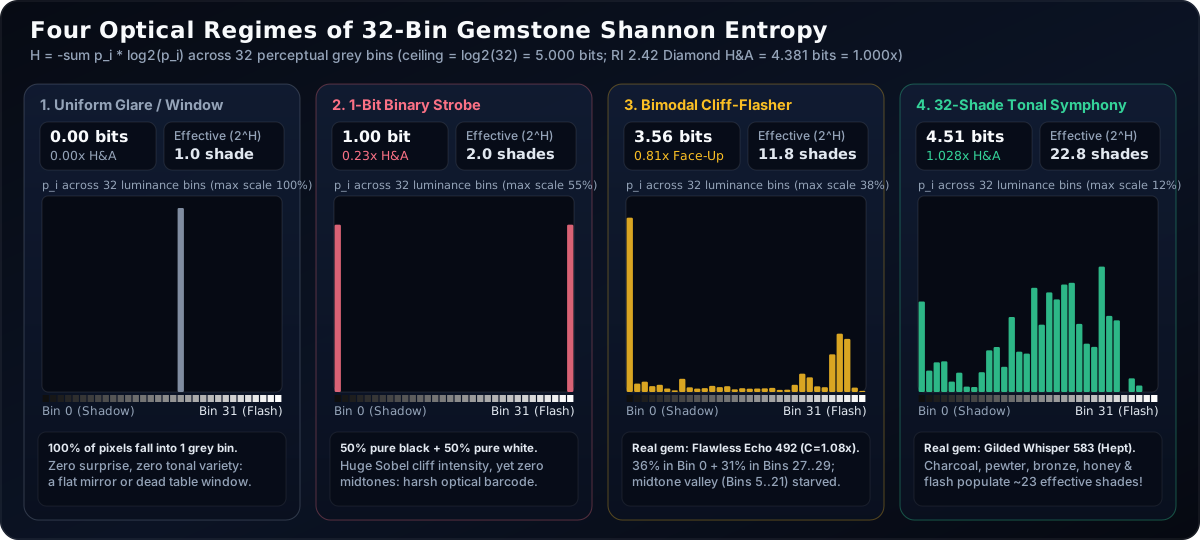
Inside The 32-bin Autopsy: Three Real Stones Under The Microscope
Probability histograms become immediately intuitive when you put real gemstones under the raytracer and inspect their tonal footprints side by side. Below are analytical face-up raytrace passes and exact 32-bin histograms for three curated OffTheDop designs spanning graphic high-voltage contrast, clean low-RI geometry, and full-spectrum liquid silver:
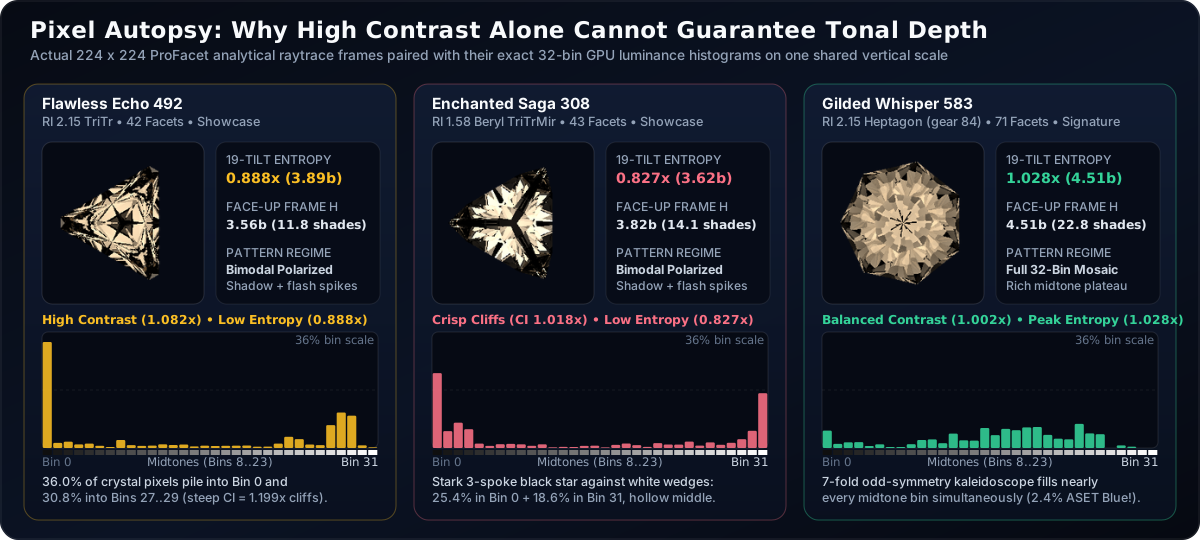
Look at how differently those three histograms distribute light:
- The high-voltage strobe (Flawless Echo 492): Over seventy percent of the crystal piles into the darkest shadow bin and the brightest highlight bins, leaving the middle sixteen buckets sparsely populated. That U-shaped split is not a defect; it is the exact optical recipe for bold, graphic piano-key flash.
- The crisp low-RI emblem (Enchanted Saga 308): In lower-refractive-index Beryl, concentrating light into a dozen clean tonal steps creates decisive triangular mirrors that read clearly even in pale Aquamarine or Morganite.
- The velvety midtone tapestry (Gilded Whisper 583): Look at the emerald bars on the right. Pure black drops to a delicate accent, and fully two-thirds of the gemstone populates the sixteen silvery midtone buckets. Because a seven-fold heptagon never places two pavilion facets directly opposite each other, incoming rays fold across skew wedges that sample many different elevation bands of the lighting dome at once.
Running this multi-angle sweep on classic Diamond Hearts & Arrows uncovered a neat gemological quirk that static grading never noticed: right at dead-center face-up, Hearts & Arrows actually dips in tonal entropy before blooming twenty percent richer in effective shades as soon as the stone tilts slightly. When all eight arrows lock into exact alignment at zero degrees, perfect radial symmetry forces all eight pavilion mains and all eight arrow shafts into identical luminance buckets, briefly compressing the stone's tonal palette until a slight wrist movement breaks the symmetry into a cascade of off-axis greys.
What 4,799 Gemstones Reveal: The Contrast Tug-of-war And The Ri Ladder
Measuring Shannon Entropy across nearly 4,800 catalog designs spanning all eight gem materials reveals four clear physical rules:
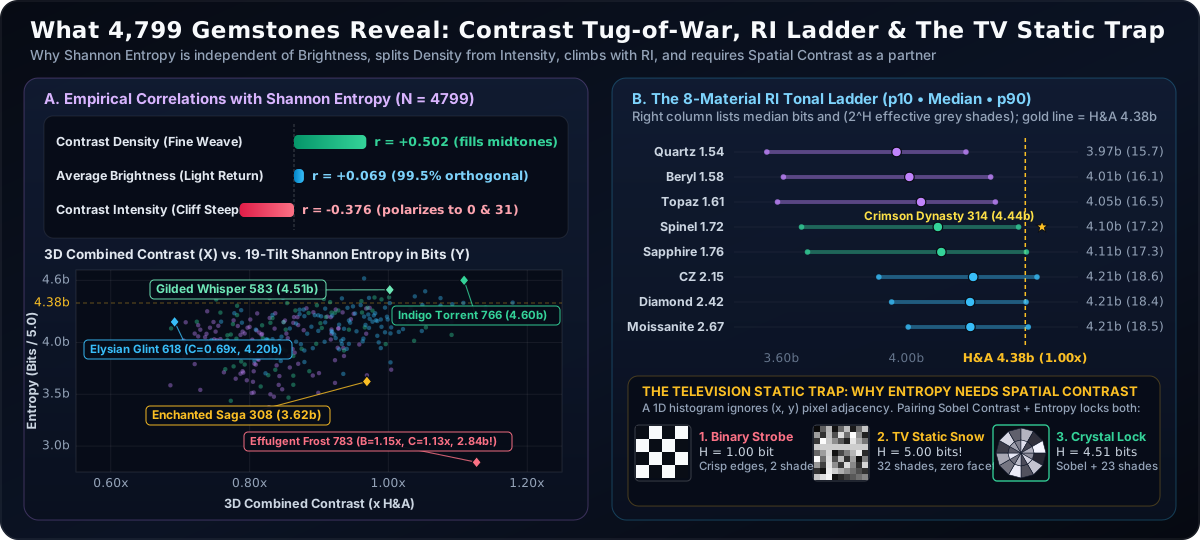
- Tonal richness costs zero brightness: Cutters sometimes assume that soft pewter and silver midtones require sacrificing total light return. Across our catalog, Brightness and Shannon Entropy are statistically independent. Designs like Diamond cushion pentagon Amber Nebula 742 and mirrored hexagon Silken Galaxy 678 return noticeably more light than Diamond Hearts & Arrows while still resolving about 23 distinct shades of grey.
- The contrast tug-of-war: Splitting contrast into Density and Intensity in our companion post explains why contrast pulls entropy in two opposite directions at once. Fine Contrast Density strongly lifts entropy by creating intermediate internal bounce angles that fill the midtone buckets. Extreme Contrast Intensity, on the other hand, pulls entropy downward by evacuating midtones and polarizing facets into stark black and white. That is how entropy catches extreme binary-strobe outliers like Effulgent Frost 783 and Turquoise Quasar 812, which post huge brightness and contrast scores yet collapse to roughly seven effective shades.
- The refractive-index ladder: As refractive index rises from Quartz up to Cubic Zirconia, Diamond, and Moissanite, the shrinking critical-angle escape cone unlocks three- and four-bounce internal ray paths, steadily expanding a material's median tonal palette. Even so, clever odd-symmetry geometry can leapfrog material limits: natural Spinel Showcase trilliant Crimson Dynasty 314 resolves more simultaneous shades of grey than a Diamond Hearts & Arrows brilliant.
- The television-static trap: Any honest introduction to a new metric should explain how it breaks if pushed alone. Shannon Entropy is a pure histogram statistic with zero spatial memory: if you scrambled a gemstone image into random uncorrelated television snow where every grey level appeared equally, entropy would hit its theoretical five-bit ceiling while looking like frosted sandpaper. On a physical lap, optimizing entropy in isolation would reward over-fragmented facet dust where no mirror is wide enough for the eye to resolve. Pairing Sobel Spatial Contrast (which enforces crisp, coherent facet structure) with Shannon Entropy (which fills those structured facets with a rich tonal palette) keeps optimization squarely in the sweet spot of coherent complexity.
Four Tonal Archetypes: Picking The Right Entropy Regime For Your Stone
Just as a photographer chooses between high-contrast film noir and rich darkroom silver-gelatin gradation, there is no single mandatory entropy score for every piece of rough. Knowing a cut's tonal entropy lets you match optical texture intentionally to your crystal and setting:
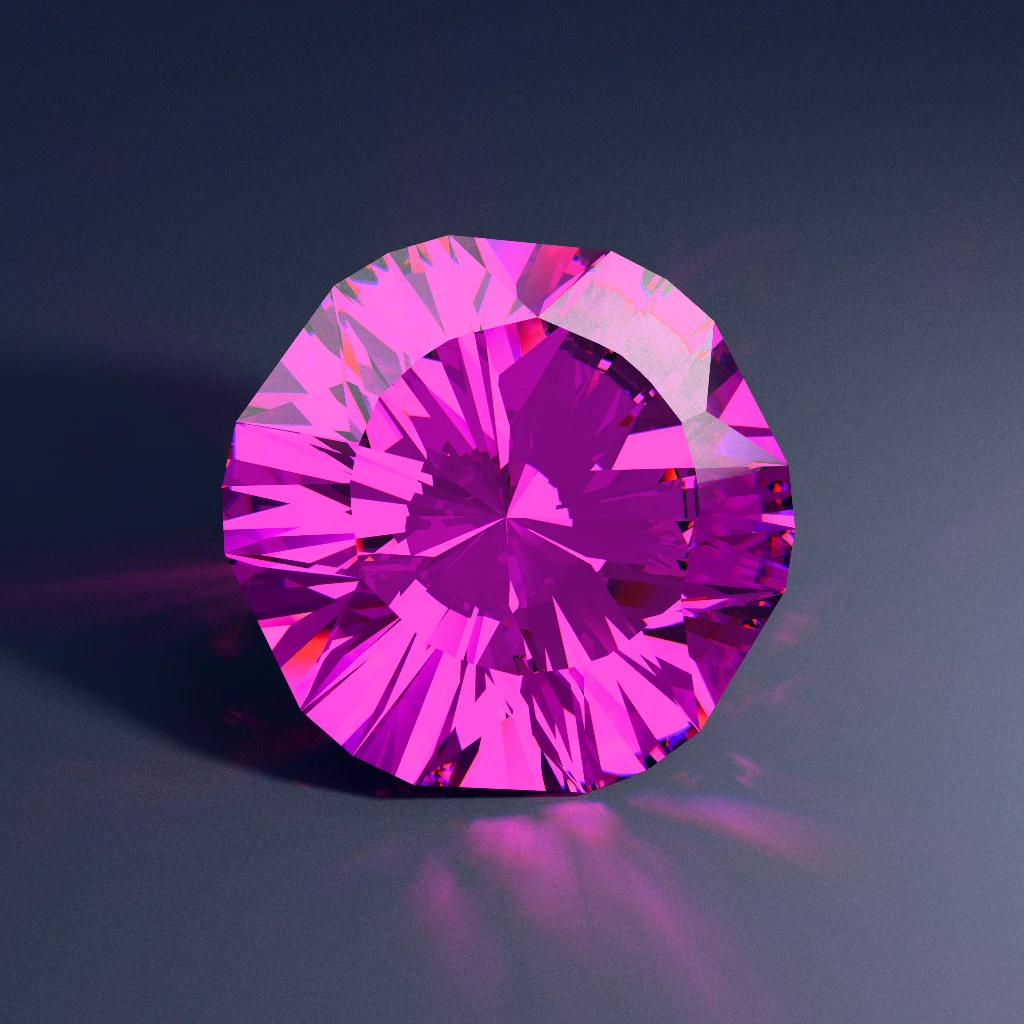
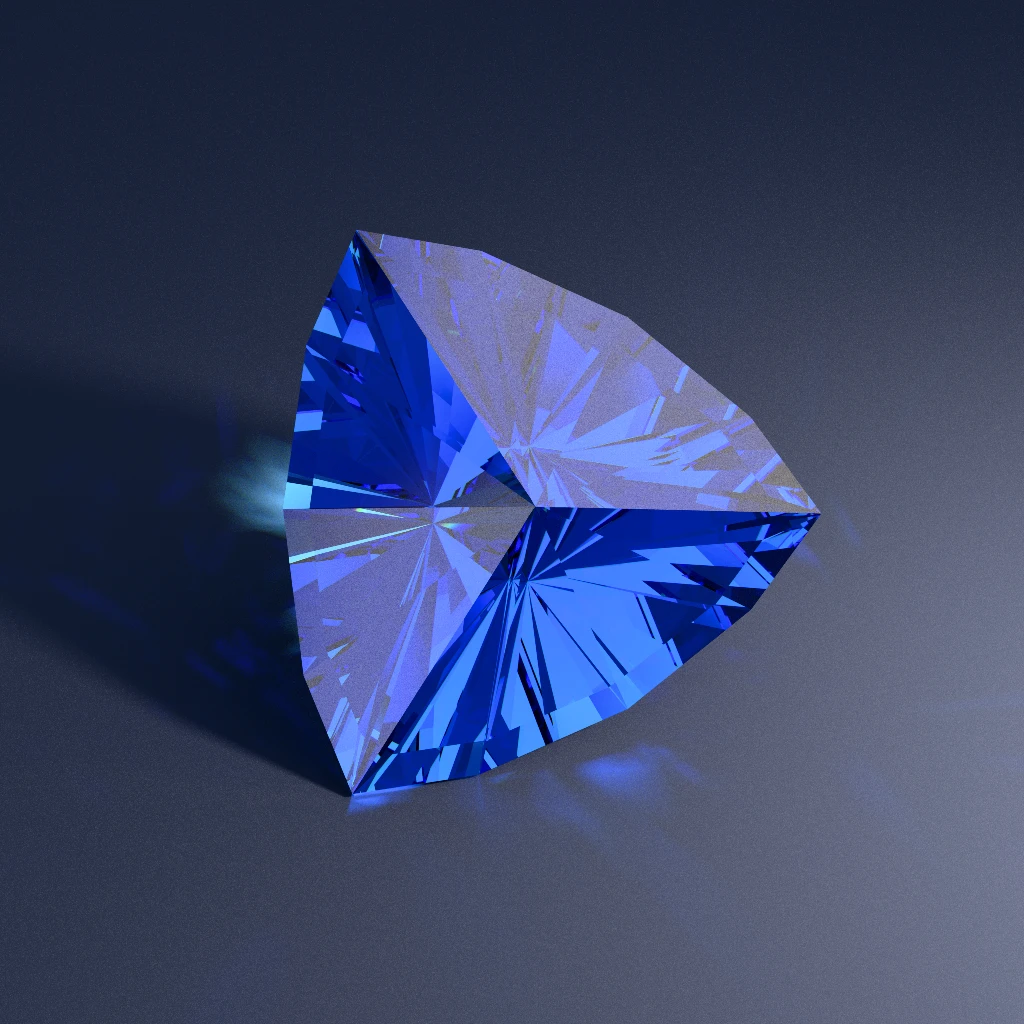
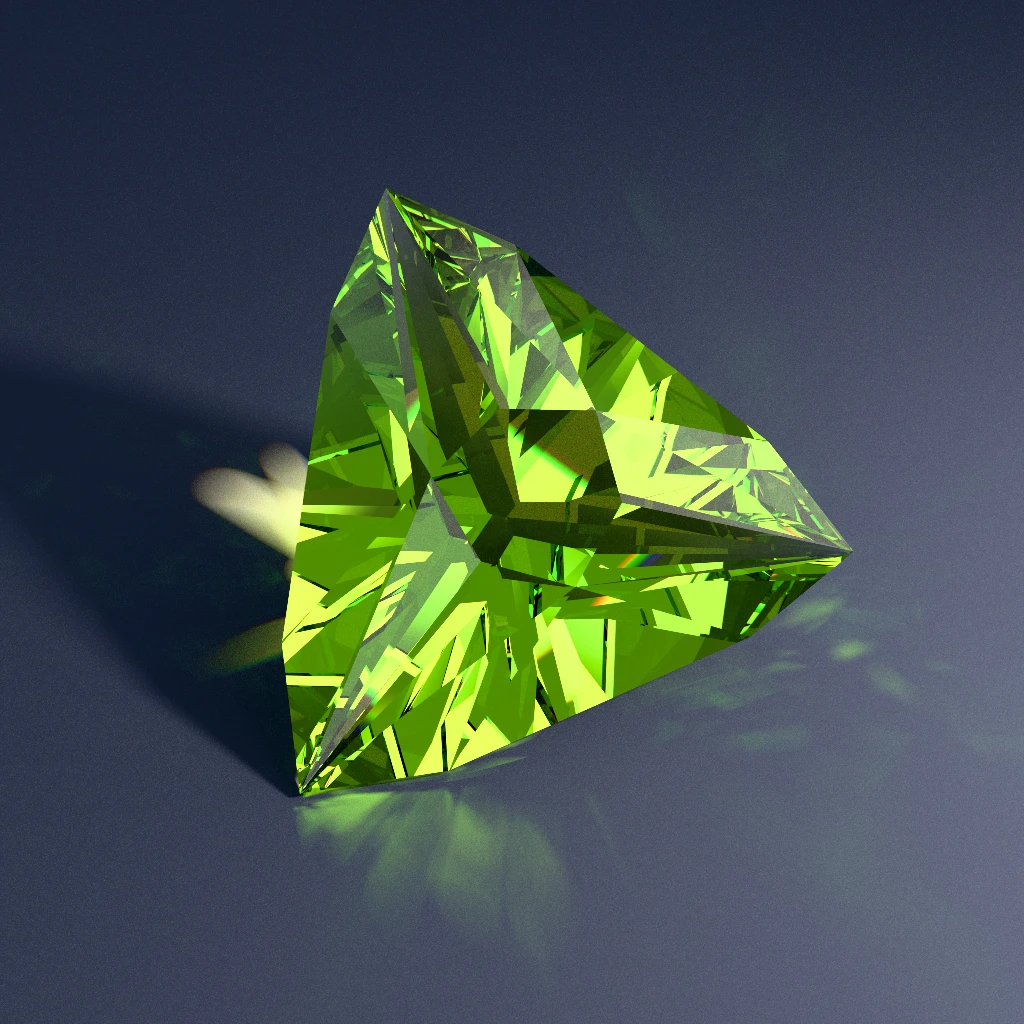
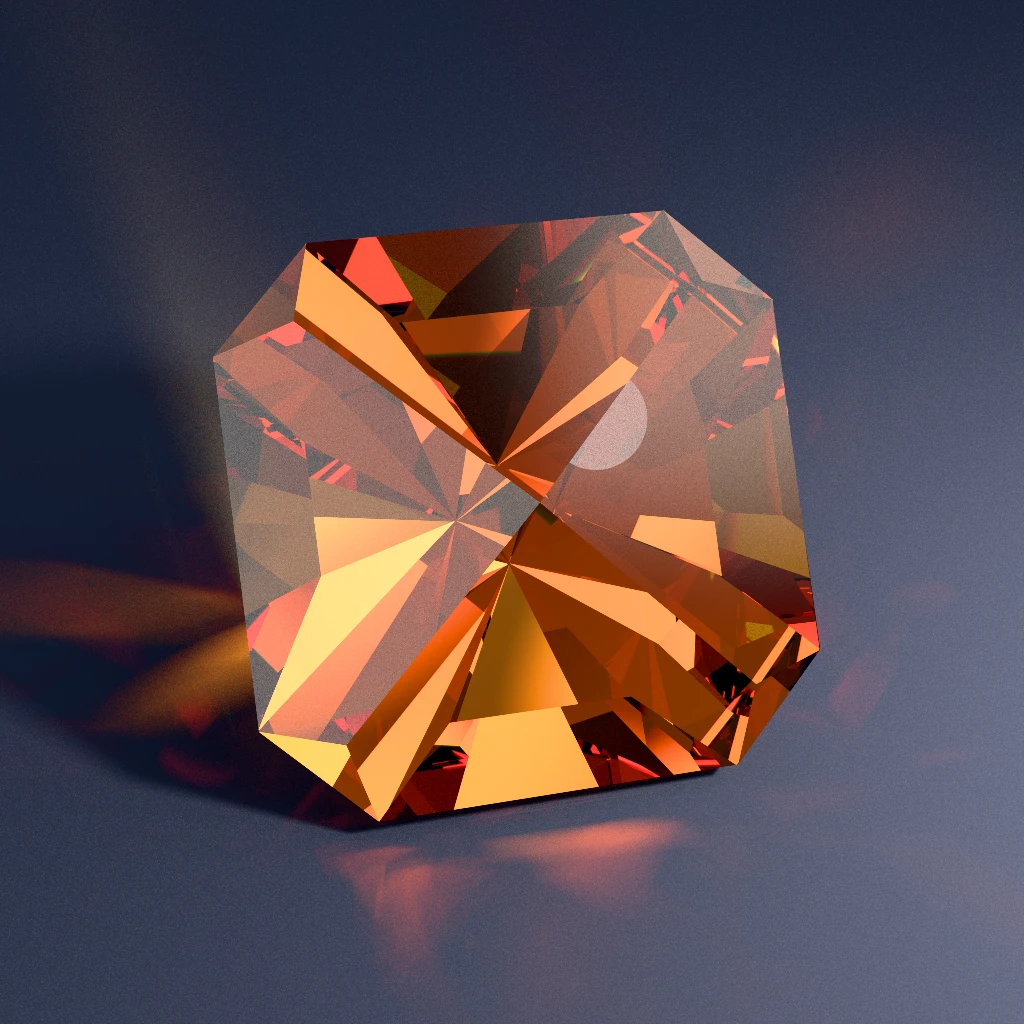
Here is how these reference designs span the tonal spectrum alongside the Diamond Hearts & Arrows baseline:
| Design | Material | Brightness | Contrast | Entropy (vs. H&A) | Effective Shades | Tonal Personality |
|---|---|---|---|---|---|---|
| Indigo Torrent 766 | CZ 2.15 | 1.03x | 1.11x | 1.05x | 24 shades | Catalog peak tonal tapestry |
| Gilded Whisper 583 | CZ 2.15 | 1.06x | 1.00x | 1.03x | 23 shades | Seven-fold liquid-silver heptagon |
| Silken Galaxy 678 | CZ 2.15 | 1.08x | 1.06x | 1.03x | 23 shades | Crushed-silk hexagonal brilliant |
| Crimson Dynasty 314 | Spinel 1.72 | 1.06x | 1.03x | 1.01x | 22 shades | Spinel beating Diamond H&A |
| Hearts & Arrows (Round ref.) | Diamond 2.42 | 1.00x | 1.00x | 1.00x | 21 shades | Classic eight-fold benchmark |
| Elysian Glint 618 | Spinel 1.72 | 0.86x | 0.69x | 0.96x | 18 shades | Calm architectural square depth |
| Enchanted Saga 308 | Beryl 1.58 | 0.95x | 0.97x | 0.83x | 12 shades | Bold graphic low-RI emblem |
| Effulgent Frost 783 | Beryl 1.58 | 1.15x | 1.13x | 0.65x | 7 shades | Bimodal black-and-white strobe |
Both ProFacet and OffTheDop place Shannon Entropy right alongside Brightness and Spatial Contrast:
- In ProFacet Studio: The live Optical Performance scorer displays normalized Shannon Entropy on every cut, and the GPU optimizer includes a dedicated Entropy weight slider. Raise Entropy alongside Contrast Density when designing odd-symmetry cushions, heptagons, or multi-tier crowns where you want deep liquid-silver gradation; lower Entropy while raising Contrast Intensity when carving compact graphic trilliants or step cuts where bold blocks of flash are the whole point.
- On OffTheDop: Every design modal reports its multi-angle Entropy score relative to Diamond Hearts & Arrows, making it easy to tell a velvety heptagon apart from a graphic trilliant before touching rough crystal to a diamond lap.
Claude Shannon wrote his 1948 theorem for copper telephone wires and teletype tape, but photons bouncing inside a faceted crystal obey the exact same mathematics of surprise. Once you start seeing gemstones in all thirty-two shades of grey, two-tone black and white never quite looks the same again.
Explore High-Entropy Cuts on OffTheDop or Optimize Tonal Depth in ProFacet
Compare 23-shade liquid-silver heptagons against bold graphic trilliants across our 92,000+ catalog, tune the Shannon Entropy slider live in ProFacet Studio, or read our companion deep dive on Computable Spatial Contrast.